


08 Oct Assistive Learning Technology: Why It Matters in the Modern Classroom
Walk into a classroom today and it looks very different from the one most of us grew up in. The chalkboard has given way to large touchscreens, walls double as interactive displays, and quiet corners are increasingly designed as calming sensory spaces. This shift isn’t about technology for its own sake. It reflects a growing understanding that students learn in different ways, at different paces, and with different needs — and that the right tools can make a genuine difference to how well they engage, retain, and thrive.
Assistive learning technology is the umbrella term for the hardware, software, and physical environments designed to support that variety. It spans interactive flat-panel displays, projectors and immersive rooms, and sensory equipment for learners with additional needs. Here’s why it has become so central to good teaching — and what the evidence actually says.
Active Engagement Beats Passive Listening
For decades, the default mode of teaching was a teacher talking at the front while students listened. We now know that approach leaves a lot of learning on the table. A frequently cited meta-analysis of 225 studies found that active learning — where students participate, collaborate, and interact with material rather than simply receive it — reduces failure rates dramatically compared with passive instruction. The challenge has always been making active learning practical at scale. That’s where assistive technology earns its place.
Interactive displays are a clear example. These large touch-sensitive screens turn a lesson into something students can manipulate directly — dragging, annotating, solving, and building together in real time. Research on interactive surfaces has shown measurable links between how students collaborate around a shared screen and how much they actually learn, with stronger joint attention correlating to better outcomes. In other words, the technology doesn’t just look modern; it changes the dynamic of the room in ways that support comprehension.
Everyone Needs to See the Lesson
One of the most overlooked barriers to learning is something deceptively simple: can every student actually see the content clearly? It’s an easy thing to assume, but studies have highlighted that a significant share of students struggle to read material on smaller flat-panel screens, and many experience eye strain from prolonged close screen viewing. For a child sitting at the back of a classroom, a display that’s too small or too bright isn’t a minor inconvenience — it’s a daily obstacle to keeping up.
This is where projectors and large-format displays come in. By scaling content up to sizes far beyond a standard panel, and even transforming entire walls into learning surfaces, they help ensure no student is left squinting or disengaged. Immersive projection takes this further, turning floors, walls, and ceilings into interactive environments that bring abstract concepts to life — a science topic, a historical setting, or a maths challenge becomes something students can step inside rather than just observe.
Supporting Learners with Additional Needs
Perhaps the most powerful case for assistive technology lies in inclusion. Not every student processes a busy, noisy classroom the same way. For learners with autism, sensory processing differences, or social, emotional and mental health needs, a typical school day can be genuinely overwhelming — and an overwhelmed child cannot learn.
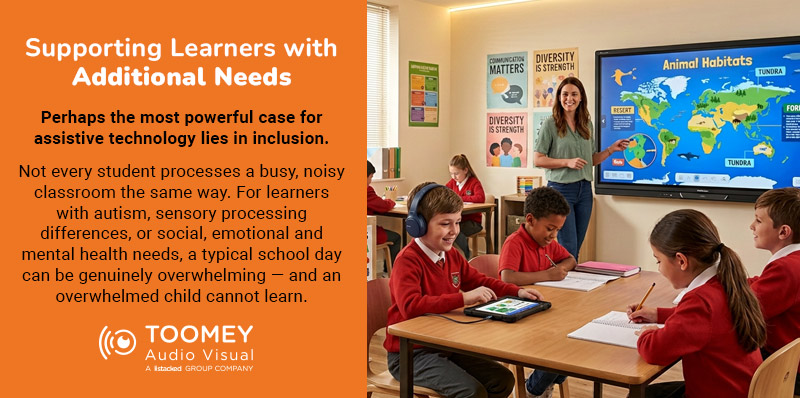
Sensory rooms and sensory pods address this directly. Research from the Wales Autism Research Centre at Cardiff University, one of the most rigorous bodies of work in this area, has explored how these spaces can support changes in engagement, attention, mood, and anxiety for autistic children. The findings point to real benefits when sensory spaces are used thoughtfully: students get a place to self-regulate, decompress, and then return to class ready to participate.
The wider research echoes this. Studies have found sensory interventions can meaningfully increase students’ readiness to engage in classroom activities, while reducing stress, aggression, and disruptive behaviour. Importantly, these spaces aren’t only valuable for students with a formal diagnosis — any child who occasionally needs to reset and refocus can benefit. The result is a more inclusive environment where a wider range of learners can succeed without being sent elsewhere for support.
A Note on Doing Assistive Learning Technology Well
Assistive technology isn’t a magic fix, and the evidence is honest about that. Research on classroom environments has also shown that cluttered, overly decorated spaces can increase cognitive load and actually distract learners — a useful reminder that more is not always better. The same principle applies to technology: a screen, projector, or sensory space delivers value when it’s purposeful, well-integrated into teaching, and matched to the needs of the students using it. The goal is always the learning, not the gadget.
This is why planning and integration matter as much as the equipment itself. The most effective installations are the ones designed around how a particular school actually teaches — its curriculum, its spaces, and its students.
Building Learning Environments That Work for Everyone
Assistive learning technology matters because it widens the door to education. It helps the student at the back see clearly, gives the overwhelmed child a place to regulate, and turns passive lessons into active, collaborative experiences. Done thoughtfully, it doesn’t just modernise a classroom — it makes learning accessible to more students, more of the time.
Assistive Learning Technology Specialists
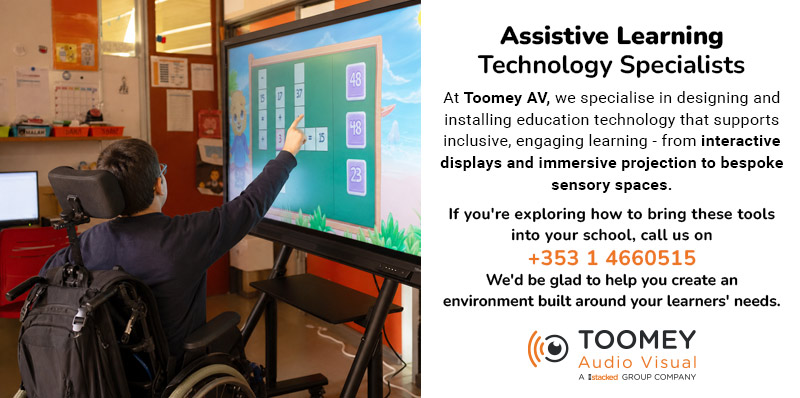
At Toomey AV, we specialise in designing and installing education technology that supports exactly this kind of inclusive, engaging learning — from interactive displays and immersive projection to bespoke sensory spaces. If you’re exploring how to bring these tools into your school, give us a call now on +353 1 4660515 or contact us online and we’d be glad to help you plan an environment built around your learners’ needs.
Sorry, the comment form is closed at this time.